
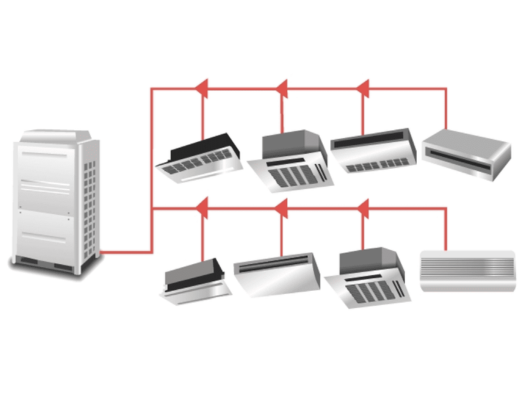
Variable Refrigerant Flow (VRF) System
A premium multi-zone cooling and heating solution designed for large residential, commercial, and industrial environments. Advanced inverter-driven technology enables precise temperature control, energy efficiency, and quiet performance across multiple indoor spaces from a single system.
Key Highlights
What is a VRF Air Conditioning System?
A Variable Refrigerant Flow (VRF) air conditioning system is an advanced climate control solution designed to provide simultaneous cooling and heating across multiple zones using a single outdoor unit connected to several indoor units. The system dynamically adjusts refrigerant flow based on demand, ensuring precise temperature management and optimized performance.
This technology enables efficient operation in complex environments where different rooms require different temperature settings. The system offers flexibility, scalability, and quiet performance, making it suitable for modern buildings that demand both performance and energy efficiency.
Ideal for Modern Buildings
VRF air conditioning systems are engineered for environments where scalability, performance, and aesthetic integration are essential. Their modular design allows customization according to building size and functional requirements.
- Single outdoor unit with multiple indoor units
- Flexible indoor unit options
- Energy-efficient inverter technology
- Compact and space-saving design
- Quiet and comfortable operation
- Suitable for large multi-room environments
How VRF Systems Work
Understanding how VRF technology functions highlights its efficiency and flexibility in modern HVAC applications:
System Components
- Outdoor VRF unit
- Multiple indoor units
- Refrigerant piping network
- Advanced control systems
- Thermostats and sensors
- Energy-efficient inverter compressor
- Electrical control panels
- Drainage system
Key Benefits
Flexible System Design
VRF systems support various indoor unit configurations such as cassette, ducted, wall-mounted, and floor-standing units. This flexibility allows customization for different architectural and operational needs.
Environment-Friendly Performance
Advanced refrigerant management and efficient operation help reduce environmental impact by minimizing energy consumption and lowering carbon emissions.
Ultra-Quiet Operation
Noise-optimized indoor and outdoor units ensure comfortable operation, making the system suitable for noise-sensitive environments.
High Energy Efficiency
Inverter-driven compressors and precise refrigerant control improve seasonal performance and reduce electricity consumption compared to conventional systems.
Scalable Architecture
The modular design enables system expansion as requirements grow, providing long-term flexibility for evolving building needs.
Reliable Performance
Engineered for demanding applications, VRF systems provide stable operation even in challenging climates, ensuring consistent comfort.
Usage & Applications
VRF Air Conditioning Systems are widely used in environments that require flexible multi-zone climate control and high energy efficiency:
Efficient climate control for open offices, cabins, and meeting rooms
Independent temperature control for guest rooms and common areas
Quiet and reliable operation for patient-focused environments
Comfortable climate without compromising interior design
Consistent cooling for classrooms and training areas
Personalized comfort for multiple rooms within a single system
Technical Specifications
System Capacity
- System Type: Multi-zone VRF
- Indoor Units: Multiple supported
- Control: Individual room control
- Operation: Cooling & Heating
Technology Features
- Compressor: Inverter-driven
- Efficiency: High seasonal performance
- Noise Optimization: Yes
- Control Interface: Wired/Wireless
Installation Details
- System Layout: Modular piping
- Indoor Options: Cassette/Ducted/Wall/Floor
- Outdoor Design: Compact footprint
- Installation: Professional required
Performance Features
- Energy Saving: Optimized inverter control
- Operation Modes: Multi-zone management
- Maintenance: Low maintenance
- Durability: Long service life